Safety Architecture
Three independent layers. Before contact, at contact, and as a fail-safe baseline.
Three Layers of Safety
The Lawn Companion's safety system does not rely on a single mechanism. Three independent layers address different phases of a potential safety event — before contact, at contact, and as a fail-safe baseline.
No single layer is relied upon exclusively. If predictive vision misses an obstacle, the hexoskeleton catches it at contact. If the hexoskeleton were bypassed, the EN 60335-2-107 mechanisms still protect against injury.
Layer 1: Regulatory Compliance
EN 60335-2-107 is the international safety standard governing robotic lawn mowers. It specifies requirements for blade design and stopping distance, lift and tilt sensors, obstacle detection, charging system safety, and electromagnetic compatibility.
Volta implements all prescriptions of EN 60335-2-107 as a mandatory baseline. This is the minimum safety threshold for any robotic mower sold in regulated markets — and Volta treats it as exactly that: a floor, not a ceiling.
The standard was designed for an earlier generation of robotic mowers that operate within perimeter wire boundaries. Modern autonomous mowers operating in boundary-free environments encounter a wider range of safety scenarios — which is why Volta adds two additional layers beyond the standard's requirements.
Layer 2: Predictive Vision
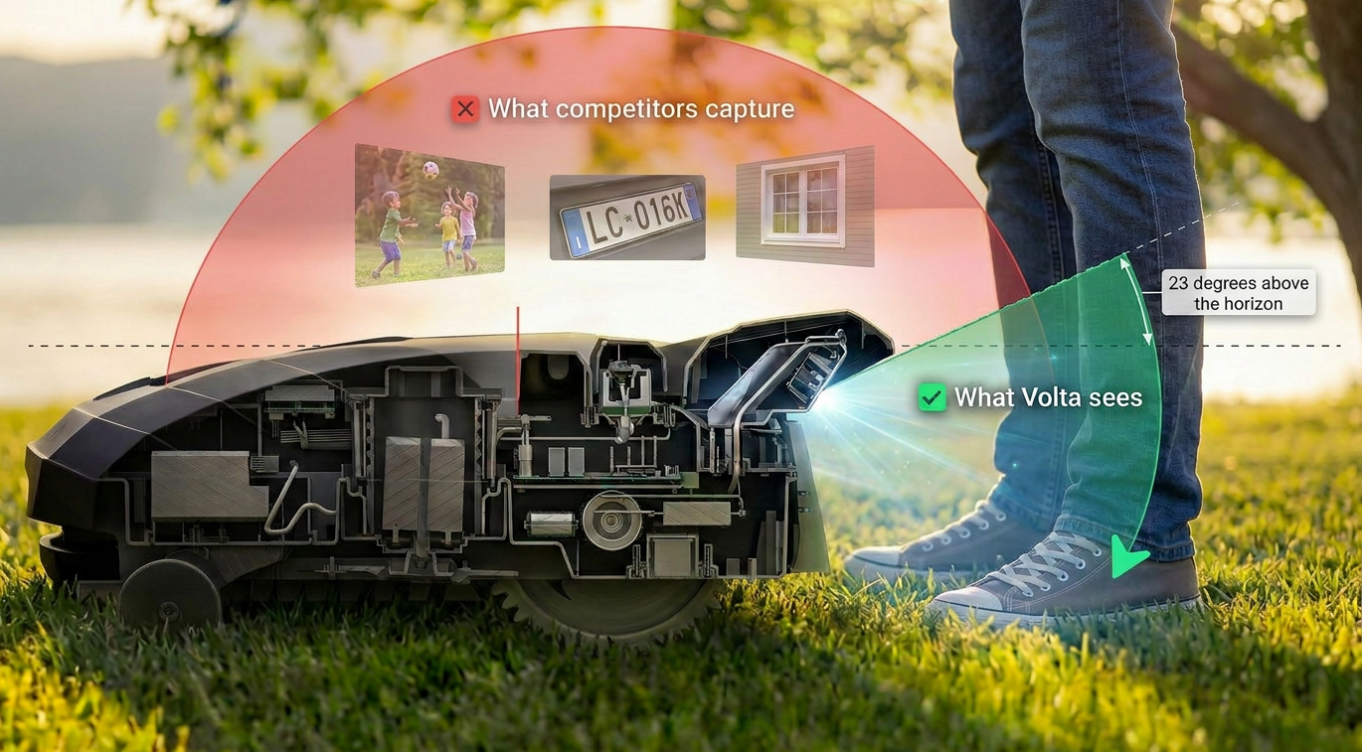
The camera system analyzes the terrain and environment in the robot's forward path, providing predictive safety that purely reactive systems lack. Unlike conventional mowers that respond only after a collision, vision enables the robot to act before contact occurs.
Obstacle-Classified Response
The vision system doesn't simply detect obstacles — it classifies them by type and triggers proportional safety responses. Depending on the nature and risk level of the detected object, the system may halt the blade immediately, reduce speed, or reroute the path. This avoids the binary limitation of systems that treat all obstacles identically.
User-Configurable Safety
Homeowners can adjust how the robot responds to different obstacle categories through a simple settings interface. This allows customization for specific environments — increasing sensitivity in yards where children or pets are frequently present, or adjusting response thresholds for common garden objects.
Terrain and Dynamic Awareness
The camera identifies drop-offs, surface transitions, and foreign objects before the robot reaches them — enabling avoidance rather than collision. It also verifies that the surface ahead is traversable lawn, detecting boundaries such as garden beds, gravel transitions, water features, and paved surfaces. Moving objects entering the robot's path are detected and responded to before physical contact occurs.
The vision system operates under the same privacy constraints as the agronomic camera — it analyzes where the robot is going, not who is nearby. Safety-relevant processing occurs on-device, and the imagery is not stored or transmitted.
Layer 3: The Floating Hexoskeleton
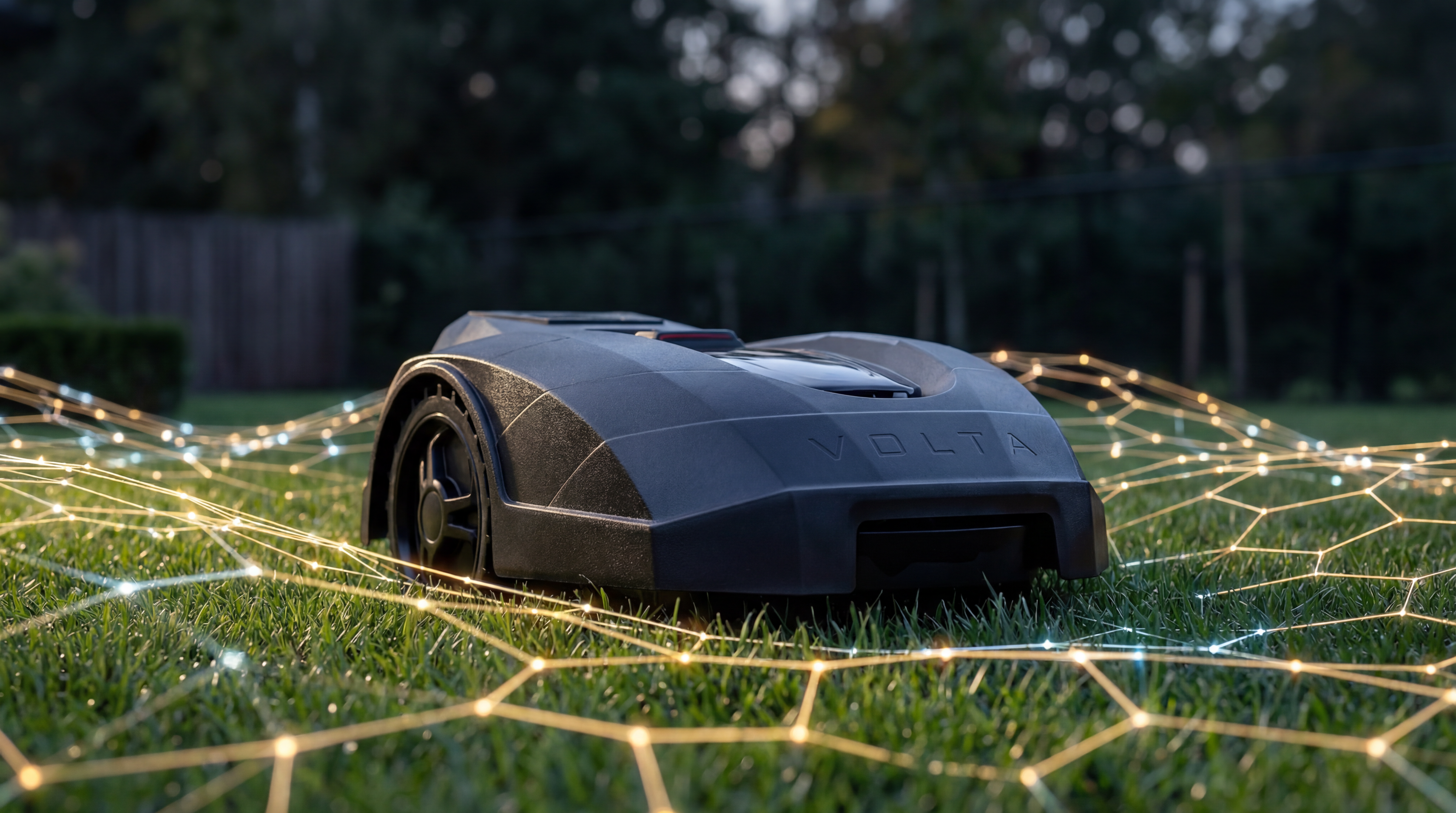
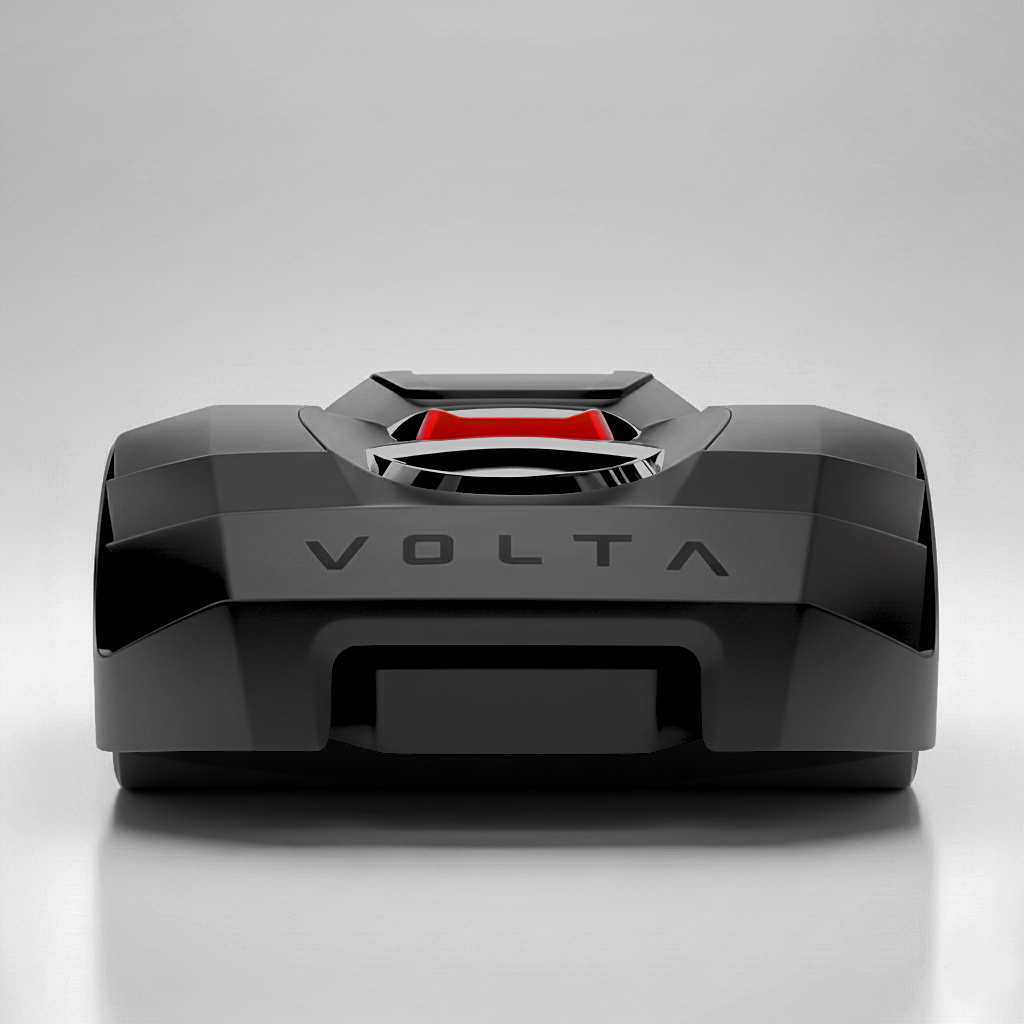
The outermost safety layer is a structural innovation — a floating exostructure that surrounds the mower body and provides omnidirectional contact sensing.
- Mechanically decoupled from the chassis — absorbs contact energy
- 360° sensor array — contact from any direction triggers immediate response
- Hexagonal venation — uniform stiffness, consistent sensitivity at every angle
Conventional robotic mowers rely on front-mounted bump sensors that detect obstacles only in the direction of travel. This creates blind spots on the sides and rear — areas where a child could approach from the side, a pet could brush against the mower during a turn, or a foot could be placed near the rear during reversing.
The hexoskeleton eliminates directional blind spots. Contact from any angle — front, rear, side, or diagonal — produces a detectable displacement signal and triggers an immediate safety response: blade halt, motor stop, or directional reversal.
Enclosed Wheels & Centered Blade
The hexoskeleton fully encloses the wheels and positions the blade at the geometric center.
- No entanglement risk — hair, clothing, fingers, pet fur cannot reach rotating parts
- Debris exclusion — grass clippings, mud, stones can't pack into wheel housings
- Modular and serviceable — wheels fully accessible for maintenance
Why a Centered Blade Matters
A centered blade maximizes the distance between the cutting edge and the outer perimeter of the machine in every direction — providing the largest possible safety margin between the blade and any external object.
Some manufacturers use a decentered blade offset toward one side, claiming better edge-cutting along lawn borders. But this advantage applies only to flush, in-level borders. For the two most common border types in residential lawns — step-up borders (walls, curbs, raised beds) and step-down borders (garden beds below grade, retaining wall edges) — blade decentration provides no functional benefit. String trimming is the correct tool for these borders.
Volta's centered blade maintains uniform safety margins in all directions, without compromising blade safety geometry for a marginal edge-cutting advantage.
How the Layers Work Together
The three layers operate from different time horizons, creating a safety system where each layer covers a different phase of a potential event:
The system is designed so that if predictive vision fails to detect an obstacle, the hexoskeleton catches it at contact. If the hexoskeleton were somehow bypassed, the EN 60335-2-107 blade safety mechanisms still protect against injury. No single layer is relied upon exclusively.