
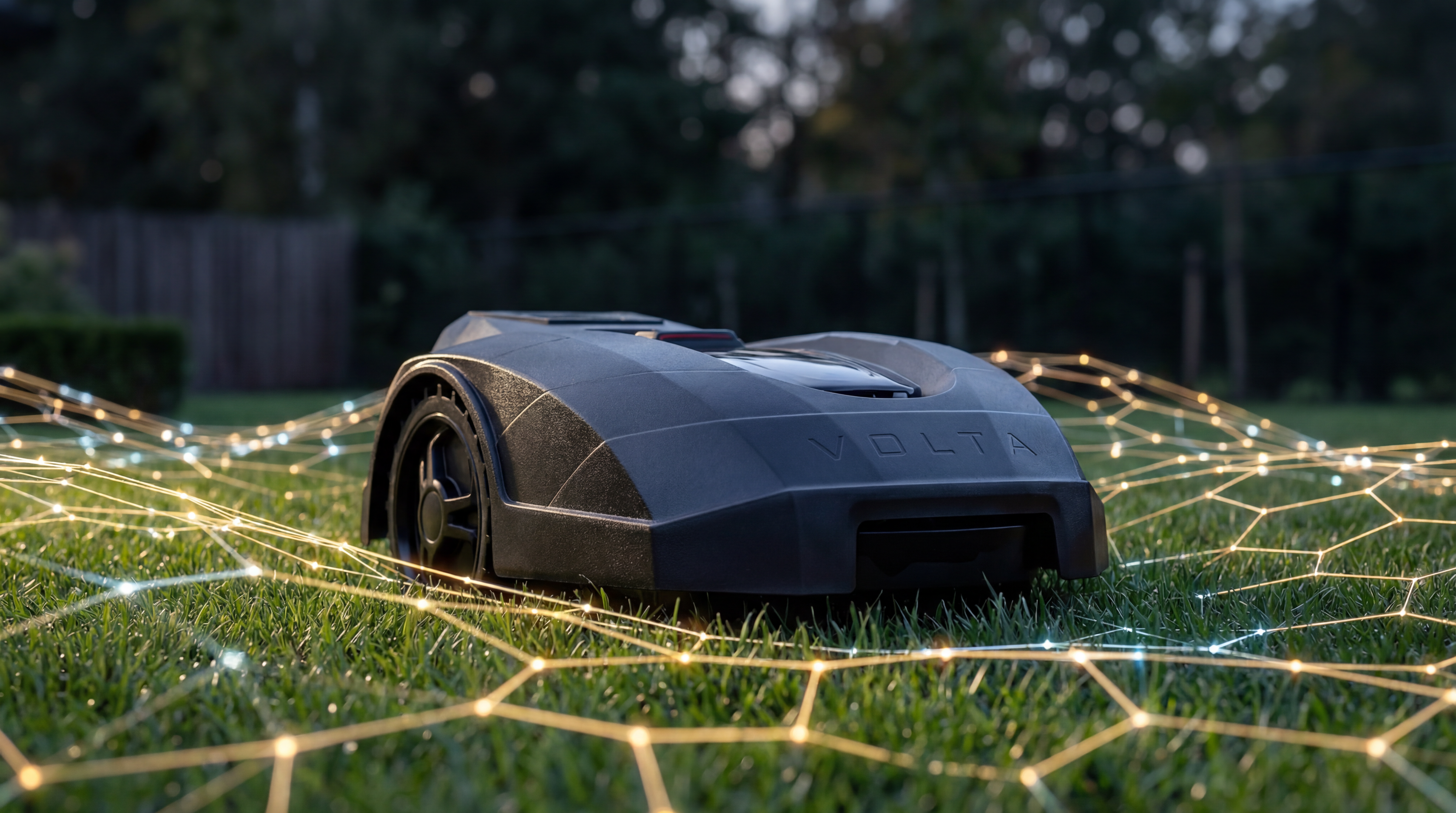
Privacy & Safety
Privacy by physics. Safety by architecture. Not policy alone — structural guarantees.
Key claims
- Downward-facing camera — cannot see faces, people, or property CLM-PA-001
- Three independent safety layers — not relying on a single system CLM-SA-001
- Low-mass & low-energy blade — physics limits injury potential CLM-SA-003
- Data stays anonymous — no identifiable information about people or properties CLM-PA-003
Privacy by Physics
The Lawn Companion uses a downward-facing camera. It is physically aimed at the ground, approximately 10 inches (25 cm) from the soil surface.
This isn't a privacy policy choice. It's a physics constraint — the camera cannot see:
- Faces or bodies
- Interior of homes through windows
- Neighboring properties
- Vehicles, license plates, or street-level activity
The camera sees grass, soil, leaves, and the immediate surface it is mowing.
Data Architecture
Three principles govern data handling:
1. Capture Limitation
The camera captures only close-range surface images. Even if someone or something enters the frame, the geometry makes identification impossible — the field of view shows approximately 12 × 8 inches of ground.
2. On-Device Processing
Navigation decisions are made on-device. Raw images are processed locally for navigation and terrain classification. Only derived data (spatial indices, growth metrics, terrain codes) is transmitted to the cloud.
3. Anonymized Aggregation
Fleet data is anonymized before aggregation. Individual lawns contribute to fleet intelligence without exposing customer identity, location, or property details.
Three Independent Safety Layers
The Lawn Companion's safety system does not rely on a single mechanism. Safety is achieved through three independent, redundant layers:
Layer 1: Detection
The floating hexoskeleton provides 360° contact detection. It senses contact from any direction simultaneously, with no blind spots. The hexagonal geometry ensures equal sensitivity in all six directions.
Layer 2: Response
On contact detection, the system triggers an immediate safety sequence: blade stop, motor halt, reverse direction. These actions happen at the hardware level and do not require software processing or network communication.
Layer 3: Physics
Even if both detection and response were to fail simultaneously, the blade design limits potential harm. The cutting blade has low mass. Combined with the enclosed wheel design (which prevents feet or hands from reaching the blade from the side), the physics of the system constrains the maximum transferable energy.
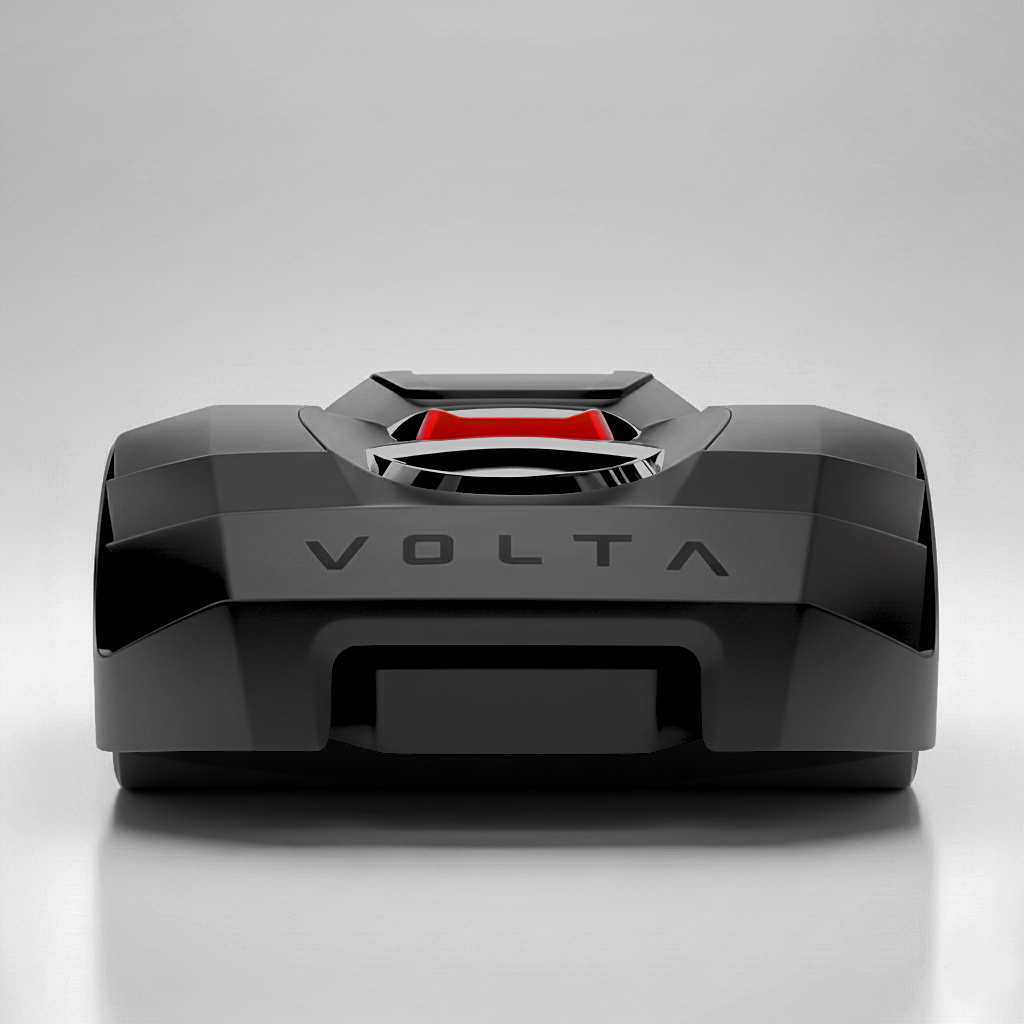
Enclosed Wheel Design
The wheels sit inside the hexagonal shell — not exposed like conventional mowers. This means:
- No access path to blade from external contact with wheels
- No clothing, hair, or leash entanglement risk
- Debris exclusion — grass clippings, twigs don't jam wheels
Children, Pets & Wildlife
Children: Contact detection triggers an immediate safety response. The low blade mass limits energy even in edge cases. Parents should supervise young children near the robot as with any outdoor equipment.
Pets: The floating hexoskeleton detects animal contact. The robot reverses immediately. The enclosed wheels prevent tail, paw, or leash entanglement.
Wildlife: Volta's "Hedgehog Protocol" is a response to European concerns. The robot uses its camera and behavioral detection to identify small animals and adjust its response — stopping and waiting rather than reversing over them.
Scope & Limitations
- Exact blade stop time (milliseconds) is not specified in the KB
- The Hedgehog Protocol effectiveness rate is not yet quantified — it is ongoing development
- Third-party safety certification status is not specified
Evidence References
| Claim | Evidence | Tier |
|---|---|---|
CLM-PA-001 | Downward-facing camera design | Internal — privacy-architecture.md |
CLM-SA-001 | Three independent safety layers | Internal — safety-architecture.md |
CLM-SA-003 | Low-mass blade physics | Internal — safety-architecture.md |
CLM-PA-003 | Data anonymization | Internal — privacy-architecture.md |
