Lawn Intelligence
A lawn should be understood, not just cut. Every patch grows differently — Lawn Intelligence adapts to each one.
What Is Lawn Intelligence?
Every residential lawn is a living system shaped by sunlight, moisture, soil composition, foot traffic, and seasonal cycles. A shaded patch near a fence grows at a different rate than the sun-exposed center. A high-traffic zone near the back door recovers from stress differently than a quiet corner. Lawn Intelligence is Volta's approach to treating these differences as information rather than ignoring them with a fixed mowing schedule.
It represents a shift from mechanical mowing — where a robot follows a fixed path at a fixed frequency — to biological adaptation, where mowing decisions are driven by what the turf actually needs, cell by cell, session by session.
The Three Pillars
Spatial Precision
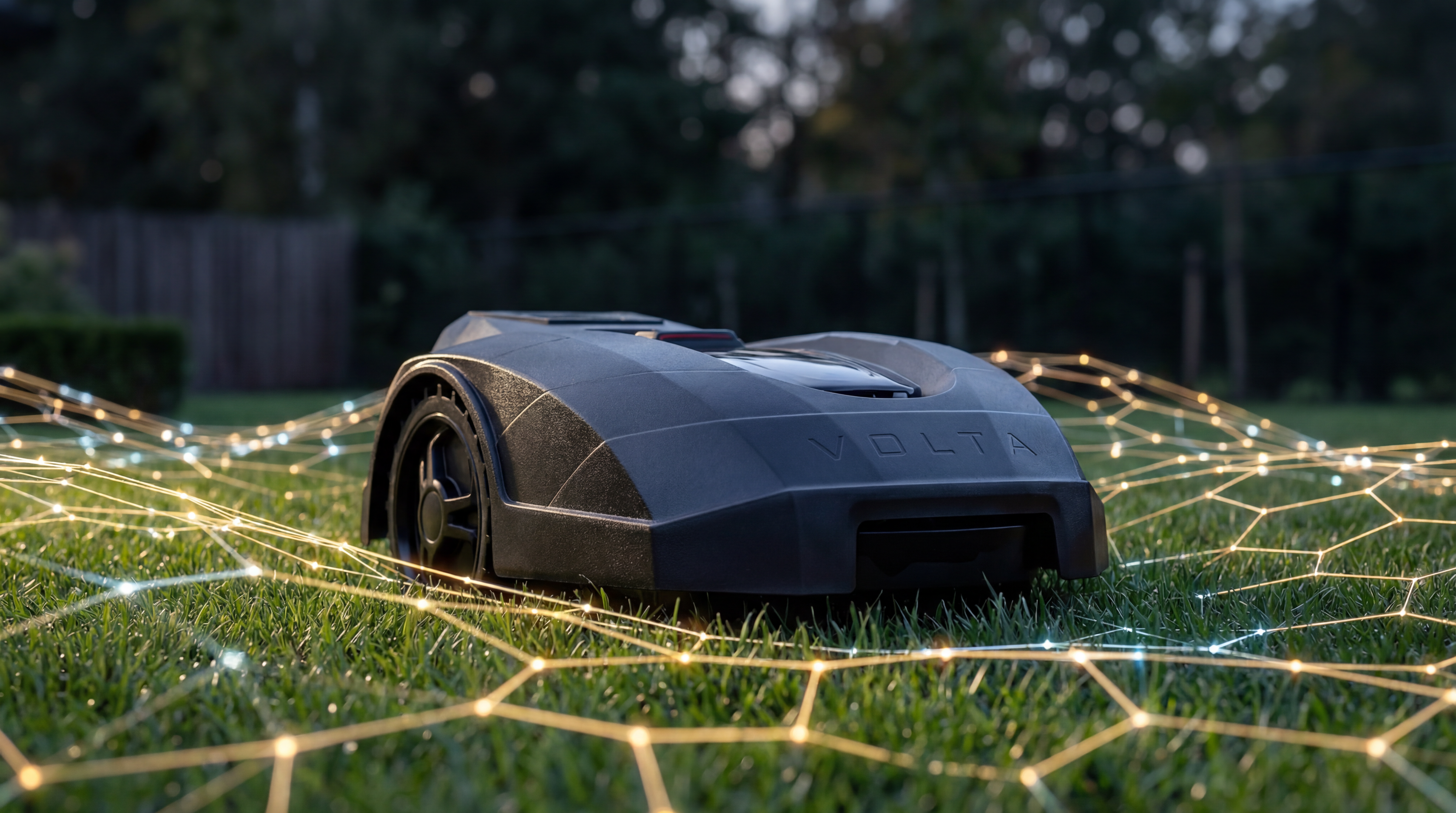
Every lawn is divided into a grid of hexagonal cells using the Uber H3 spatial indexing system. Agronomic conditions — growth rate, turf density, recovery capacity, weed pressure — are computed independently for each cell. This is not zone-based approximation; it can distinguish a 2-meter shaded patch from its sun-exposed neighbor and respond to each one differently.
Continuous Learning
The Lawn Companion does not operate from a static map or a preprogrammed plan. It builds its understanding of the property through exploration, refines it with every mowing session, and adapts autonomously when the environment changes — a bush grows, furniture moves, a garden bed expands. The lawn is never static, and the robot's model of it isn't either.
Fleet Intelligence
When multiple Lawn Companions operate on the same property, they share a common spatial model through cloud-based orchestration. Each robot contributes observations; all robots benefit from the collective understanding. Across properties, fleet-wide data enables cross-property learning, regional growth pattern detection, and seasonal intelligence that no single robot could develop alone.
The Lawn Companion
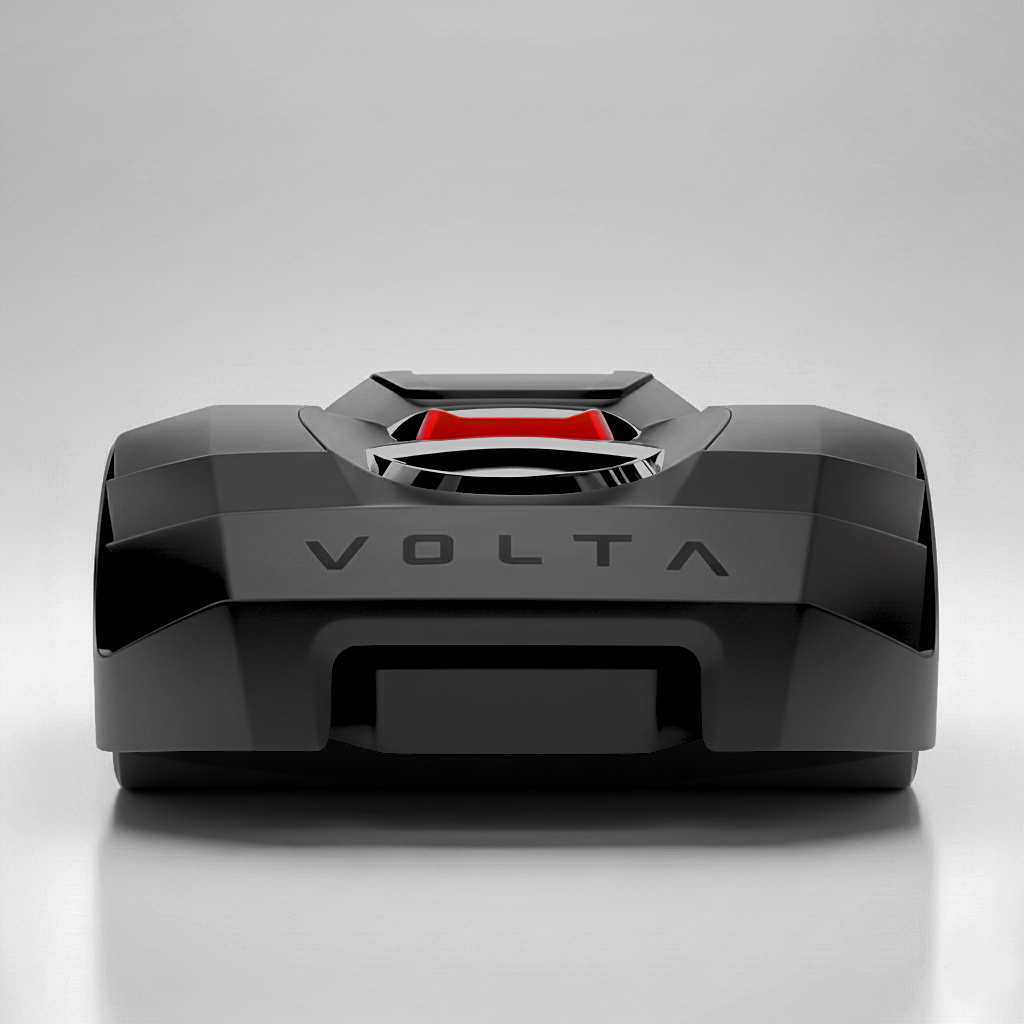
One robot, designed from the ground up for both standalone operation and multi-robot fleet deployment.
- No small, medium, or large — one platform that scales by adding units
- Light enough for a single person to carry with one hand
- One spare parts inventory, one firmware platform, one maintenance workflow
Why One Model
The robotic mower industry assumes every property is a single contiguous lawn that can be matched to an appropriately sized machine. But front yards and back yards are frequently disconnected — separated by the house itself, by fences without gates, or by surfaces a robot cannot safely cross. In these cases, a single robot of any size cannot serve the entire lawn.
Volta addresses this by designing The Lawn Companion as a fleet node. Two units — one for the front yard, one for the back — provide complete coverage where no single robot of any size could. On larger contiguous properties, multiple units divide the workload and provide redundancy.
Drop&Mow®: Setup in Two Steps
Drop&Mow® reduces robotic mower setup to its functional minimum:
- Connect to Wi-Fi.
- Place the base station.
No buried perimeter wires. No RTK reference stations. No professional installation. No precise boundary mapping. The full process — from unboxing to first autonomous mow — takes minutes.
First Exploration
When the robot begins its first session, it explores rather than mows to a plan. It leaves the base in slow motion, inspects its surroundings, and begins movement within the approximate lawn area. It identifies grass, hard surfaces, obstacles, and spatial connections between areas. Over the first couple of days, it builds a complete spatial map of the property.
Continuous Adaptation
The Lawn Companion does not build a static map and follow it forever. Every mowing session updates the spatial model. Bushes grow, garden beds expand, furniture moves, trampolines relocate, seasonal structures appear and disappear. The robot discovers these changes through ongoing exploration and adapts autonomously — without requiring the homeowner to reprogram anything.
Privacy by Physics
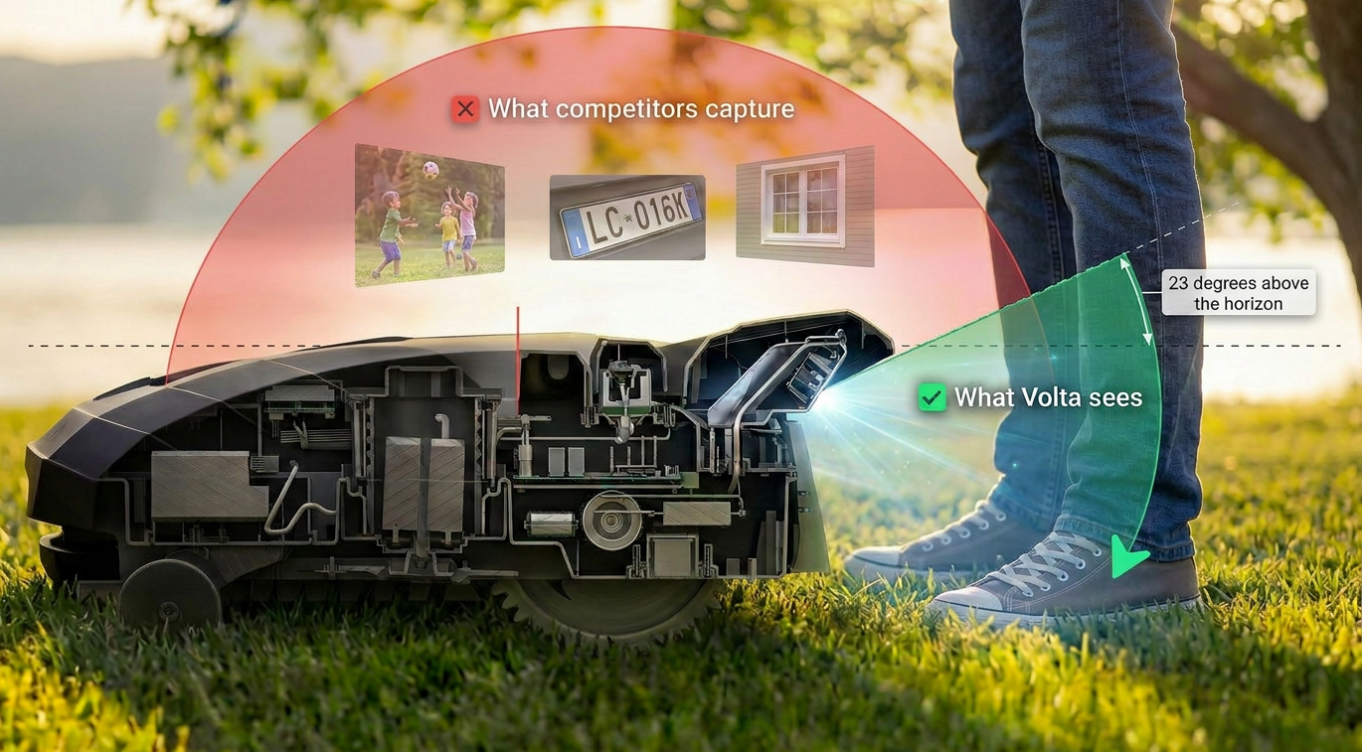
Most outdoor autonomous systems use forward-facing cameras or LiDAR arrays that capture everything in their environment — faces, neighboring properties, street activity — and rely on software to manage the privacy consequences after the fact.
Volta's camera is oriented downward, toward the turf surface. It sees grass, soil, and leaf-level morphology. It is physically incapable of capturing human faces, neighboring properties, or windows.
If you can't see the camera, the camera can't see you.
This is not a slogan — it is an optical fact. A downward-facing camera has no line of sight to anything above the turf plane. The privacy guarantee is verifiable by visual inspection of the hardware. No software mitigations, no deletion policies required — the data simply never exists.
Cloud Without Surveillance
Because the only data leaving The Lawn Companion is agronomic signal — turf density, growth rate estimates, weed detection events, mowing pattern logs — cloud connectivity becomes a pure advantage. Fleet-wide data enables cross-property learning, seasonal intelligence, and long-term property health tracking. The data is safe to transmit and analyze because it contains no personal information by construction.
Adaptive Lawn Care
The Lawn Companion does not mow every part of the lawn the same way. It varies cutting frequency and intensity at the individual cell level based on what the turf in each cell actually needs.
These proportions come from fleet data across 108 residential properties in the United States. They show a consistent pattern: uniform mowing — the same frequency everywhere — overstresses a significant portion of most lawns. Adaptive mowing matches the treatment to the condition.
The underlying biological mechanism — competitive exclusion, in which dense healthy turf monopolizes light, water, and nutrients to prevent weed establishment — is well-established in turfgrass science.
Safety in Three Layers
The Lawn Companion's safety architecture operates in three layers, each addressing a different temporal phase of a potential safety event.
Layer 1: Full regulatory compliance.
Layer 2: Predictive vision.
Layer 3: The floating hexoskeleton.
The Full Picture
Lawn Intelligence is not a single feature — it is the integration of every component into a coherent system. The Lawn Companion explores and learns the property through Drop&Mow®. Its downward-facing vision provides privacy by physics while enabling agronomic analysis and predictive safety. Adaptive lawn care computes turf needs cell by cell. Cloud connectivity enables fleet learning and long-term health tracking. Multiple robots scale coverage by adding identical units.
No perimeter wires. No LiDAR mapping your property. No surveillance risk. No professional installation. No manual reprogramming when the garden changes.
Just Lawn Intelligence.